Driver Guide
Where to Charge Your Electric Truck in Kent, WA: Heavy-Duty EV Stations Near I-5 and the Kent Valley (2026 Driver Guide)
If you're running an electric Class 6-8 rig through the Kent Valley in 2026, you already know the deal: the freight is here, the warehouses are humming, and the charging infrastructure is finally star
If you're running an electric Class 6-8 rig through the Kent Valley in 2026, you already know the deal: the freight is here, the warehouses are humming, and the charging infrastructure is finally starting to catch up. Kent sits at the heart of one of the busiest distribution corridors on the West Coast, wedged between the Port of Seattle, the Port of Tacoma, and SeaTac. That means a lot of drayage, a lot of last-mile, and increasingly, a lot of battery-electric trucks rolling through.
This guide breaks down where you can actually plug in a heavy-duty EV in and around Kent right now, what's coming online in the next 12-18 months, and how to plan your runs so you don't end up stranded with a dead pack at a passenger car charger that can't fit your tractor.
The Current State of Heavy-Duty Charging in Kent
Let's be straight with you: public, truck-accessible charging in Kent is still thin, but it's growing fast. Kent itself has roughly 60 public charging ports (Level 2 and Level 3) within a 15km radius, but most of those are sized for passenger cars and won't accommodate a Class 8 tractor or a tractor-trailer combo. What's changing is the dedicated heavy-duty buildout.
King County is funding hundreds of new chargers across the county — from fleet stations to public fast charging in Kent and Renton — that will soon join the state's growing charging network. That's the most relevant local development for drivers right now: Kent is specifically named as a public fast-charging build-out target.
On the freight side, CALSTART says some major trucking corridors are moving faster than others in deploying zero-emission infrastructure, pointing to highways like I-5 and I-10 as examples where public electric truck charging infrastructure is ramping up, while other major freight routes including I-80 and I-95 are still largely in the planning phase. Good news for you — I-5 through Kent is on the priority list.
I-5 Corridor Charging: What You Can Actually Use Today
If you're running north-south freight, the I-5 corridor is where the real heavy-duty network is taking shape. Skycharger's West Coast Highway Corridor (WCHC) DC Fast Charging Network — originally built at highway exits throughout California — is being expanded to include stations from Oregon to Washington, creating a continuous corridor that spans from Mexico to Canada. That puts Kent right on the spine of the buildout.
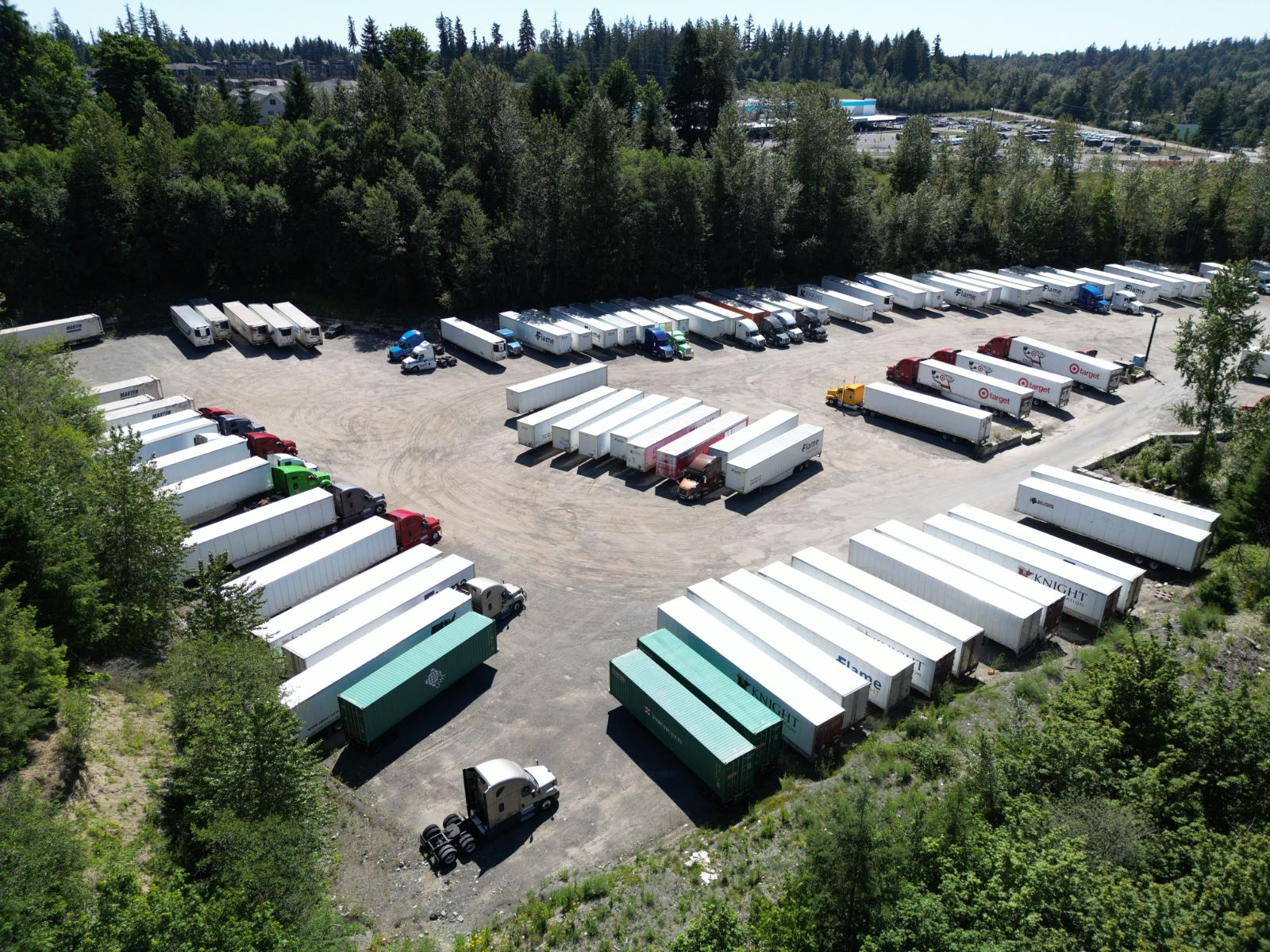
Looking for truck parking? Browse Flame Truck Parking — daily, weekly, and monthly options across the Pacific Northwest.
WSDOT is pushing federal money into the corridor as well. In early 2026, WSDOT planned to invest Round 2 NEVI funding for new and existing EVSE sites along the remaining 1,493 miles of designated Alternative Fuel Corridors that need to be built out to meet NEVI requirements, including I-5, I-405, I-82/I-182, US-12, and US-101. For Kent-based drivers, that means more sites within range of your daily loops — I-5 and I-405 both run right through your operating area.
WSDOT also recently put real money on the table. WSDOT awarded five companies a total of $12.16 million in federal funding under the National Electric Vehicle Infrastructure Program to build 14 new electric vehicle charging stations along Interstate 90, US 97, US 195 and US 395. NEVI Round 1 grant recipients include Electric Era, Energy Northwest, EV Gateway, EVgo, and Tesla, and between the five companies, they will build charging stations within the next 24 months at 14 key locations along four interstate highways. If you're running east over Snoqualmie Pass to Ellensburg, Yakima or Spokane, those I-90 sites are the ones to watch.
What "Heavy-Duty" Charging Actually Means in 2026
Not every DC fast charger is built for your truck. A 150kW car charger isn't going to do much for a 565kWh battery pack on a Tesla Semi or a Freightliner eCascadia.
The real game-changer is the Megawatt Charging System. Most trucks using an MCS charger will be able to go from a 20% SOC to 80% SOC in 30-40 minutes — about 10 times the speed of using CCS chargers. The MCS stations being developed today are for Class 6-8 commercial trucks and plan to deliver between 1MW and 1.68MW of power, depending on the specific installation.
For Kent drivers, the closest large-scale MCS deployment to keep an eye on is the Pilot/Tesla partnership. The Tesla charging stations will be built at select Pilot locations in California, Georgia, Nevada, New Mexico and Texas, along I-5, I-10 and other major corridors where the need for heavy-duty charging is highest, with the first sites expected to open in Summer 2026, each hosting four to eight charging stalls featuring Tesla's V4 cabinet charging technology, which can deliver up to 1.2 megawatts of power at each stall. Washington isn't in the first wave, but the corridor logic almost guarantees Pacific Northwest sites follow.
Practical Tips for Kent-Based EV Truck Drivers
Here's how to actually run electric out of the Kent Valley without losing your shift to a charging headache:
Plan around your depot, not around public stations. Most heavy-duty EV operations in Kent today are depot-charged overnight. Public fast charging is a top-off and emergency tool, not your daily plan.
Use the CALSTART map before you leave the yard. CALSTART launched the Medium- and Heavy-Duty Infrastructure Map in 2024 as a public tool to help truck fleets locate charging and hydrogen refueling stations, and works directly with infrastructure providers to keep station data up to date and verify that locations are actually accessible to commercial zero-emission trucks. That last part matters — it tells you whether you can physically pull a tractor-trailer into the site.
Don't trust a generic EV map. Passenger EV charging maps are ubiquitous, but commercial trucking has very different requirements — a site that works for a sedan or SUV is likely to be unusable for a Class 8 truck hauling freight.
Know the regulatory tailwinds. The Northwest Seaport Alliance must establish and coordinate a zero-emission truck stakeholder group to lead the development and implementation of at least one zero-emission drayage truck demonstration project and develop a roadmap to shift the NWSA cargo gateway fleet to zero-emission trucks, by 2050. If you're a drayage operator out of Kent serving the Port of Seattle or Tacoma, this is coming for your fleet — early adopters will have first crack at the best charging slots.
Keep an eye on grid capacity. The CALSTART map now includes grid-capacity scenario layers showing projected peak charging loads for 2026, 2030, and 2035, comparing managed and unmanaged charging scenarios to highlight where truck charging demand could put extra pressure on the grid and where more planning or utility investment may be needed. Kent Valley has a lot of warehouse load already — peak-time charging will eventually mean peak-time pricing.
Parking and Charging: The Combined Problem
Here's the catch nobody warns you about when you switch to electric: you don't just need a charger, you need a charger plus a place to legally and safely park your rig while it's plugged in. A 40-minute MCS session is fast for charging, but you still need space for a 70-foot combo to sit. And if you're staging for a morning dock appointment at one of the Kent Valley DCs, you may want to charge overnight — which means secure parking that can accommodate a cable run.
That's where Flame Truck Parking comes in. We connect drivers and owner-operators with verified truck parking spots across the Kent Valley and the wider Puget Sound region, including locations near I-5, I-405, and SR-167 — exact
Need a parking spot?
Browse verified truck parking across the Pacific Northwest. Daily, weekly, or monthly — your call.
Find ParkingRelated articles
Driver Guide
NEVI Round 1 Just Funded New WA Fast Chargers—What Kent-Based Owner-Operators Need to Know in 2026
6 min read
Driver Guide
Planning HOS-Compliant Charge Stops Out of Kent: Pairing Truck Parking with DC Fast Charging on I-5 and I-90
6 min read
Driver Guide
Northwest Seaport Alliance Zero-Emission Drayage: What Kent Port Drivers Should Expect from the 2026 Charging Rollout
7 min read