Driver Guide
Northwest Seaport Alliance Zero-Emission Drayage: What Kent Port Drivers Should Expect from the 2026 Charging Rollout
If you run containers between the Port of Seattle, the Port of Tacoma, and the warehouses lining Kent's industrial corridor, the next 12 months are going to reshape how you fuel up. The Northwest Seap
If you run containers between the Port of Seattle, the Port of Tacoma, and the warehouses lining Kent's industrial corridor, the next 12 months are going to reshape how you fuel up. The Northwest Seaport Alliance (NWSA) zero-emission drayage rollout is no longer a slide deck — the trucks are arriving, the SeaTac charging depot is opening, and the rules around your truck are tightening. Here's what Kent-based port drivers and owner-operators need to know right now about zero emission drayage truck charging Kent and the surrounding gateway.
What's Actually Rolling Out in 2026
The headline program is the NWSA's first-ever Zero Emission Drayage Incentive Program (ZEDIP). The Northwest Seaport Alliance launched a $6.2 million incentive program, funded by WSDOT, to deploy 19 zero-emission drayage trucks and charging infrastructure in the Puget Sound region by 2026, with Zeem Solutions as the program's subrecipient. Those 19 Class 8 Kenworth battery-electric tractors are being placed with six local fleet operators — not a far-off pilot in California, but rigs that will pull boxes out of T-18, T-30, Husky, and Washington United Terminals and run them right through Kent on the SR-167 and I-5 corridors.
The anchor charging site sits between you and the docks. The Zeem project includes developing a strategically located charging site near the I-5 exit ramp south of SeaTac Airport, along SR-99. The facility will accommodate charging for 250 vehicles daily and provide overnight parking for 70 vehicles. Construction is scheduled to begin in fall 2025, with zero-emission vehicles expected to be operational by 2026. For Kent drivers, that's roughly a 15-minute deadhead from the warehouse district — far closer than any comparable public Class 8 charger in the region today.
The depot is also being engineered with serious power behind it. The SeaTac Depot will be completed by early 2026 and Zeem is working closely with Puget Sound Energy to access 7.5MW of capacity at the site. That's the kind of capacity that supports fast charging multiple Class 8 tractors simultaneously, which is exactly what drayage duty cycles demand.
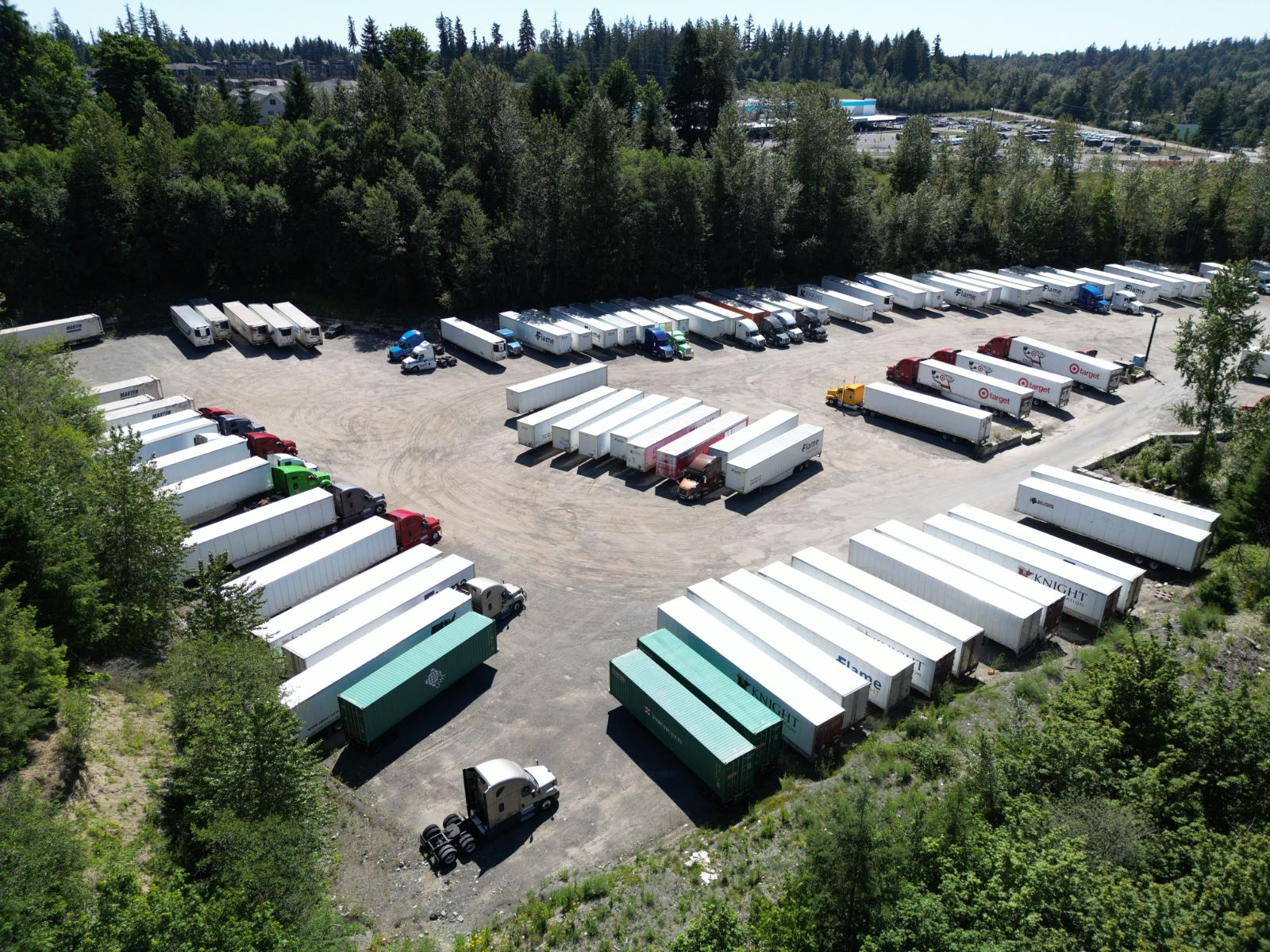
Looking for truck parking? Browse Flame Truck Parking — daily, weekly, and monthly options across the Pacific Northwest.
Why Kent Drivers Are Squarely in the Crosshairs
Kent isn't incidental to this rollout — it's the operational center of gravity. The charging site will be located near the new I-5 exit ramp just south of SeaTac Airport, along SR-99 (International Blvd / Pacific Hwy), convenient for nearby warehouse and distribution centers that see a large volume of truck deliveries. If you're hauling out of Kent Valley distribution centers, you'll either be charging at SeaTac or staging in Kent between turns. There's no third option that pencils out.
The operational profile fits Kent runs almost perfectly. An ICCT analysis of telematics data from 10 drayage trucks over 22 months, driver surveys from 31 operators and over 465,000 points of port terminal gate data from 5 major port terminals in the Seattle-Tacoma region revealed three distinct operational categories with substantially different daily distance requirements and infrastructure needs, including a Local category characterized by 7-8 short daily trips within 40 miles of ports. That "local" bucket is exactly the Kent–Tacoma–Seattle triangle, and it's the lane where battery-electric drayage trucks make the most sense today.
Funding is also stacking on top of the NWSA grant. In July, the Northwest Seaport Alliance granted $5.12M to Zeem Solutions to develop a commercial fleet charging depot in SeaTac, WA, and enable six fleet operations to deploy Class 8 trucks at the Ports of Seattle and Tacoma. The SeaTac Depot will enable 250 vehicles to charge per day, with parking capacity for 70 vehicles overnight. The City of Seattle layered an additional $1.5M in truck-purchase rebates on top of that, with 12 new electric Class 8 trucks that will primarily serve the Port of Seattle coming through that pipeline.
What This Means for Your Day-to-Day
Here's the practical reality you should plan around in 2026:
Charging access is leased, not owned. Most drivers in this first wave aren't buying chargers — they're using Zeem's depot model. After a competitive bid process, the NWSA identified Zeem Solutions as the awarded subrecipient. Zeem offers charging, parking, fleet management services, and electric vehicle leases to help fleets transition to zero-emissions vehicles. If you're an owner-operator, expect a turnkey arrangement: pull in, plug in, eat, sleep, roll out.
Trucks are heavily subsidized, but still expensive. Don't expect to walk onto a lot and buy one cheap. Through interviews with applicants, OSE heard from drivers that the available funding was not enough to offset the sizeable costs of electric trucks, which can cost more than $500,000, and involve additional costs such as charging infrastructure and higher insurance. That's why most of the first 19 are placed through fleet partners and lease structures.
Leasing is how most drivers are getting in. Six local fleet operators are taking part in this new program, each with different levels of involvement. Some are leasing the trucks to keep costs lower. If you're an owner-operator hauling for one of those six fleets, ask now whether you're on the shortlist for a seat in one of these trucks.
Clean Truck Program compliance is non-negotiable. Even if you're not going electric yet, the diesel rules tightened on January 1. As of January 1, 2026, all trucks serving both international and domestic container terminals must have a registered RFID tag and a 2007 (or newer) engine, or a certified equivalent emission control system. If your truck doesn't meet that bar, you're not getting through the gate — full stop.
The Cautious Take from Working Drivers
Not every Kent-area owner-operator is jumping in headfirst, and that's fair. Dawit Habte, who owns Afar Trucking with facilities in Tacoma and Seattle, wrote in a text to KNKX, "It is a great initiative. I hope the momentum continues across the industries." Habte said he is holding off for now on getting into any of the new trucks. The current economic environment is just too challenging with so much uncertainty due to the Trump administration's tariffs. Shipping volumes are down, and with them, drayage contracts.
Other operators see opposite incentives. One operator said that he already has shipping customers asking for zero-emissions transportation for their goods – and prospects for even more of that kind of business. So he's going all in and working with Zeem to ensure he has adequate parking and charging. "If you bring electric trucks, yeah, we're gonna get a more jobs – we got offers," he said. Some BCOs (Beneficial Cargo Owners) are now putting zero-emission drayage in their RFPs — if you can pull one of those loads, you can charge a premium.
Looking Past the First 19 Trucks
This isn't a one-and-done program. The NWSA's Clean Truck Program is working to facilitate a just and equitable transition to zero-emission drayage trucks by 2050 or sooner – as called for in the recently adopted NWSA 2026-2030 Clean Air Implementation Plan. Zeem itself is signaling expansion: "These 19 trucks will be the beginning, and we expect to have hundreds of trucks operating out of that SeaTac site," Paul Gioupis, CEO of Zeem, told the crowd. "We're also looking at properties actively today, right now, in the Seattle port, and we're also looking in the Tacoma port, where we're going to see ourselves growing here the next few
Need a parking spot?
Browse verified truck parking across the Pacific Northwest. Daily, weekly, or monthly — your call.
Find ParkingRelated articles
Driver Guide
CCS vs. NACS vs. Megawatt Charging: A Kent Driver's 2026 Cheat Sheet for Class 8 EV Connectors and Pricing
6 min read
Operator Playbook
How Auburn Lot Owners Can Tap Washington's $112M Heavy-Duty EV Voucher Program to Justify On-Site Truck Charging
6 min read
Operator Playbook
I-5 Freight Corridor EV Charging: Why Auburn Truck Lots Are Prime Sites for 2026 NEVI-Funded Build-Outs
6 min read