Driver Guide
Planning HOS-Compliant Charge Stops Out of Kent: Pairing Truck Parking with DC Fast Charging on I-5 and I-90
If you run an electric or hybrid rig out of the Kent Valley, you already know the math is different. A diesel fill is 15 minutes at any Pilot or Love's. A DC fast-charge session for a Class 8 tractor
If you run an electric or hybrid rig out of the Kent Valley, you already know the math is different. A diesel fill is 15 minutes at any Pilot or Love's. A DC fast-charge session for a Class 8 tractor can eat 45 minutes to two hours — and that clock is ticking against your 14-hour window the whole time. The drivers winning this game are the ones treating charging and parking as a single planning problem, not two separate ones. This guide walks you through how to do exactly that leaving Kent on I-5 or I-90 in 2026.
Why Kent Is Ground Zero for EV Truck Planning in the PNW
Kent sits at the intersection of two designated Alternative Fuel Corridors. I-5 and I-90 are designated as Alternative Fuel Corridors, which means the state is actively building heavy-duty charging on the same routes you're already running. WSDOT announced grants on Jan. 29 to build 14 new electric vehicle charging stations along Interstate 90, US 97, US 195 and US 395, with Secretary of Transportation Julie Meredith calling them projects that "fill key gaps in the state's highway EV charging network."
For your eastbound runs out of Kent, that matters. The new EV charging stations will be located along I-90 in Cle Elum, Ellensburg, George, Issaquah, Moses Lake, North Bend, Ritzville and Veradale — basically every logical stop between Kent and the Idaho line. The buildout is funded and underway, with five companies set to build charging stations within the next 24 months at 14 key locations along four interstate highways.
On the I-5 side, the corridor is more mature. DC fast charging stations along Interstate 5, US 2 and parts of I-90 let drivers travel "border-to-border" along the 276 miles of I-5 between Washington's borders with Oregon and Canada, with fast-charge stations strategically placed every 40 to 60 miles. Around Kent itself, there are 143 EV charging stations within a 10-mile radius of the center of Kent, WA — though most are light-duty and not pull-through friendly for a 53-footer. That's the gap that planning has to bridge.
The HOS Math: Build Your Charge Around Your Break, Not the Other Way Around
Here's the rule that drives every decision: property-carrying CMV drivers in 2026 must comply with four core limits — the 11-Hour Driving Limit, the 14-Hour Window, the 30-Minute Break required after 8 consecutive driving hours, and the 60/70-Hour Weekly Limit, with a 34-hour restart that resets the weekly clock. None of that has changed for EV drivers. What changes is how you use the 30-minute break.
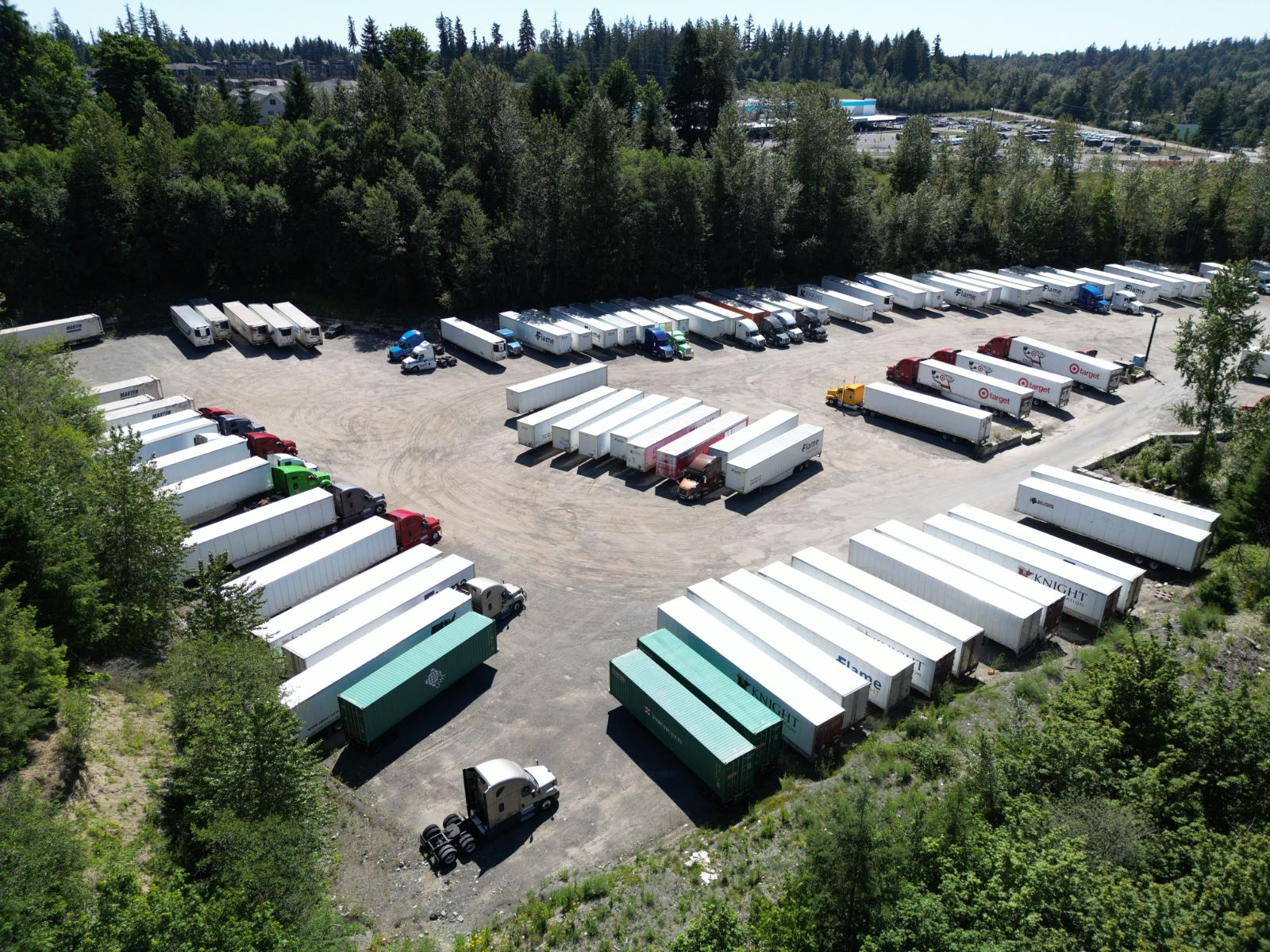
Looking for truck parking? Browse Flame Truck Parking — daily, weekly, and monthly options across the Pacific Northwest.
The smart move is stacking your mandatory rest with a charging session. After 8 cumulative hours of driving, you must take a 30-minute break before driving again. This can be off-duty, sleeper berth, or on-duty not driving — and on-duty not driving time (like loading or fueling) now counts toward the 30-minute break. Plugging in counts. If you start a charge session and log off-duty or on-duty-not-driving, those 30 minutes are doing double work.
Don't cut it close. Don't wait until you're 8 hours into driving with nowhere to stop — take it at hour 6–7 when you have options. With charging, that advice is doubled. If you push to hour 8 and the only DCFC stall is occupied, you're stuck with a violation risk plus a queue. The penalty side is brutal: violating HOS rules can lead to immediate out-of-service orders, civil penalties up to $16,000 per offense, and a blemish on a carrier's Safety Measurement System (SMS) score.
Where to Actually Plug In Heading East on I-90
I-90 out of Kent (via I-405 north to I-90 east) is where heavy-duty charging is scaling fastest in 2026. CALSTART's tracking confirms it: some major trucking corridors are moving faster than others in deploying zero-emission infrastructure — highways like I-5 and I-10 are examples where public electric truck charging infrastructure is ramping up, while other major freight routes including I-80 and I-95 are still largely in the planning phase.
Tesla is also putting Washington on the Megacharger map. Florida, Georgia, Illinois, and Washington state each have 4 locations in the pipeline, and the Washington state and Oregon sites extend the I-5 coverage all the way to the Pacific Northwest. Pilot is building too — the first sites are expected to open in Summer 2026, and each location will host four to eight charging stalls featuring Tesla's V4 cabinet charging technology, which can deliver up to 1.2 megawatts of power at each stall.
Practical eastbound stops from Kent in 2026:
- North Bend / Issaquah — funded NEVI sites coming online, good for a 30-minute top-up before the Snoqualmie climb
- Cle Elum — natural HOS-break spot at roughly 80 miles out
- Ellensburg — another funded site, useful if you're running through to Spokane
- Moses Lake / Ritzville — fills the long middle gap
Heading South or North on I-5: Plan Around Stall Availability
I-5 is denser but busier. The biggest mistake drivers make is showing up assuming a stall is open. Checking real-time availability before driving to a station is not optional; it's a practical necessity. Use PlugShare, ChargePoint, or your network app before you commit to an exit.
Pricing varies. In the U.S., public charging rates typically range from $0.25 to $0.60 per kWh, and ChargePoint DC fast charging typically runs $0.20 to $0.40 per kWh depending on the station host, while EVgo pay-as-you-go DC fast charging starts at $0.34 per kWh plus a session fee. For a Class 8 that's pulling 300+ kWh per session, the difference between $0.34 and $0.52 is real money — worth picking your stops on rate, not just convenience.
One thing to plan around: connector type. CCS2 (global markets) and CCS1/NACS (North America) are the working standards for current production trucks. Every electric truck on the road today charges via CCS. If you're running a Tesla Semi, you're on the Megacharger network. Everyone else is on CCS — confirm the stall type before you commit.
Build a Repeatable Routine
The drivers who run electric reliably out of Kent treat their daily schedule as a fixed template:
- Pre-trip in Kent with a full SoC. Overnight at depot or at a parking facility with onsite charging beats any corridor stop.
- Pick your 30-minute break stop before you roll. Don't improvise.
- Confirm stall availability 30 minutes before arrival via your app.
- Log status correctly. Off-duty or on-duty-not-driving during the charge — never driving status while plugged in.
- Have a backup exit. If your first choice is queued, know the next charger that fits your remaining drive time.
And remember the enforcement environment. The enforcement landscape and documentation requirements tightened significantly through 2026, and the 2026 CSA SMS overhaul doubled the severity weight of OOS violations to 2 (vs 1 for non-OOS) — meaning HOS-driven OOS findings now hit carrier scores twice as hard as they used to. A charging delay that pushes you past the 14-hour window is
Need a parking spot?
Browse verified truck parking across the Pacific Northwest. Daily, weekly, or monthly — your call.
Find ParkingRelated articles
Driver Guide
Northwest Seaport Alliance Zero-Emission Drayage: What Kent Port Drivers Should Expect from the 2026 Charging Rollout
7 min read
Driver Guide
CCS vs. NACS vs. Megawatt Charging: A Kent Driver's 2026 Cheat Sheet for Class 8 EV Connectors and Pricing
6 min read
Operator Playbook
How Auburn Lot Owners Can Tap Washington's $112M Heavy-Duty EV Voucher Program to Justify On-Site Truck Charging
6 min read