Industry News
Washington's Advanced Clean Trucks Rule in 2026: How ZEV Mandates Are Reshaping Federal Way Freight
Federal Way sits at the crossroads of one of the busiest freight corridors in the Pacific Northwest. Between the Port of Tacoma to the south, SeaTac and the Kent Valley distribution hubs to the north,
Federal Way sits at the crossroads of one of the busiest freight corridors in the Pacific Northwest. Between the Port of Tacoma to the south, SeaTac and the Kent Valley distribution hubs to the north, and I-5 running straight through town, almost every box of goods moving up or down the West Coast passes nearby. That makes Washington's evolving zero-emission vehicle (ZEV) rules more than a policy debate — they directly affect what trucks roll through 320th Street, what powers them, and where they park.
In 2026, the Washington Advanced Clean Trucks rule has entered its most consequential phase yet. Drivers, carriers, and shippers all feel the changes in different ways, but everyone serving Federal Way freight needs to understand where the rules stand right now and what they mean for daily operations.
What the Advanced Clean Trucks Rule Actually Requires in 2026
Washington adopted the California Air Resources Board's Advanced Clean Trucks (ACT) rule in late 2021. On November 29, 2021, Washington state's Department of Ecology adopted CARB's Advanced Clean Trucks rule, which requires truck manufacturers to increase sales of zero-emission medium- and heavy-duty trucks in the state, and the state also adopted the Zero Emission Vehicle Program for light-duty trucks.
The mechanics are important: these manufacturer regulations don't impose purchasing requirements on individuals or businesses; they don't apply to used or off-road vehicles; and they don't prohibit anyone from continuing to operate a gas- or diesel-powered vehicle in Washington. In other words, an owner-operator running a 2018 Peterbilt through Federal Way is not being told to scrap the truck. The rule pushes manufacturers to deliver an increasing share of ZEVs into the Washington market.
Beginning with model year 2025, manufacturers were required to sell zero-emission trucks as an increasing percentage of their annual sales for Class 2b through Class 8 vehicles in Washington, including all-electric and fuel cell electric vehicles. The 2026 model year tightens those percentages further, and a parallel low-emission rule kicks in for new diesel trucks too. From model year 2026 onwards, any new on-highway medium- or heavy-duty internal combustion engine vehicles sold or registered in Washington State must meet stricter emissions standards for nitrogen oxides (NOx), particulate matter (PM), and greenhouse gases.
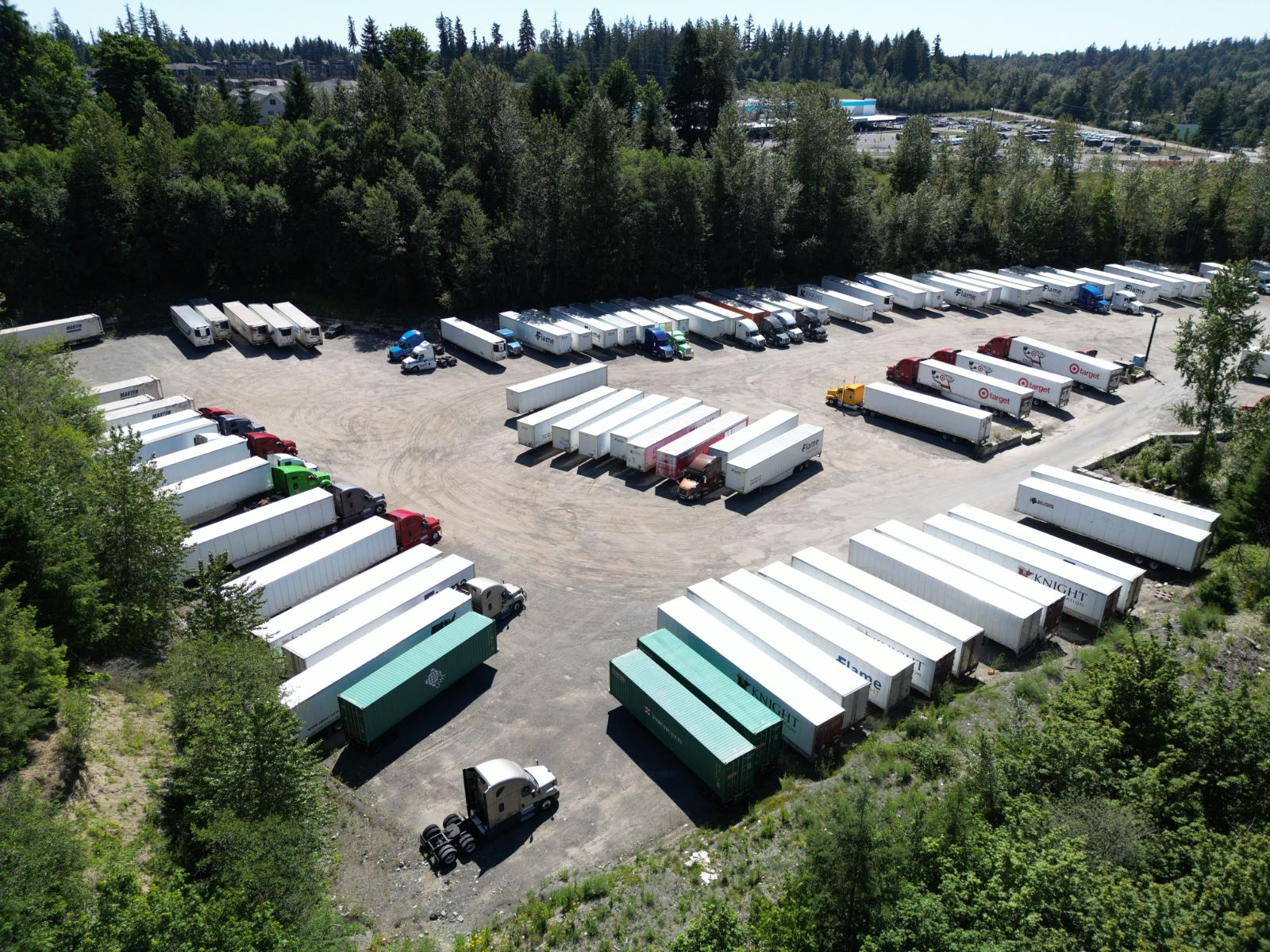
Looking for truck parking? Browse Flame Truck Parking — daily, weekly, and monthly options across the Pacific Northwest.
The 2026 Wildcard: Federal Pushback and Ecology's Pause
The story changed dramatically in mid-2025. In June 2025, President Trump signed three Congressional Review Act resolutions repealing California's Clean Air Act waivers for Advanced Clean Cars II, Advanced Clean Trucks, and the Low NOx Omnibus Rules. A multi-state coalition immediately sued, and the situation remains in legal limbo into 2026.
Washington's response has been pragmatic. Ecology temporarily paused portions of some vehicle emissions standards in response to recent federal actions and is continuing its clean vehicles rulemaking while hosting "ZEVergreen" dialogue sessions to develop new clean vehicle strategies for Washington. For Federal Way freight operators, that means the framework is still in force — but enforcement details and timelines are being actively reworked.
A second important adjustment: tractor sales (the Class 7-8 sleepers and day cabs that dominate I-5 long-haul) have lagged. Zero-emission tractor sales have been slower and less predictable, so it's unclear whether manufacturers are on track to comply; however, Ecology's current rulemaking eases Class 7-8 tractor sales requirements and gives manufacturers three years to make up shortfalls. That breathing room matters for the drayage and regional haul carriers that account for most of the heavy traffic between the Port of Tacoma and Kent.
What Federal Way Freight Looks Like Under the New Rules
The practical effects on local trucking show up in three places: equipment availability, infrastructure, and the secondary used-truck market.
Equipment availability. Fleet owners and dealers will see more and more light-, medium-, and heavy-duty ZEVs available for purchase each year because manufacturers are required to increase ZEV sales as a percentage of new vehicle sales through 2035. Vans for last-mile delivery to Federal Way's residential routes are the easiest segment to electrify, followed by drayage tractors running short loops to the port. Long-haul sleepers remain hardest.
Infrastructure. This is where Federal Way actually has a strategic advantage. The federal government announced awards under the Charging and Fueling Infrastructure grant program for Washington, Oregon, and California to build an electric truck charging corridor along the entirety of I-5, and the state has secured over $55 million in state and federal funding to electrify drayage trucks operating in and around ports. I-5 runs right through town, and Federal Way's proximity to Tacoma's drayage fleet positions it as a natural staging point for early heavy-duty charging deployment.
The used market. This is where many independent operators feel the squeeze. The Washington Trucking Association has long argued the rule will distort the market. For now, Washington fleet and truck owners will likely keep older, less efficient trucks longer to avoid the higher costs and uncertainty from purchasing ZEV medium- and heavy-duty trucks; delaying these purchases will trickle down into the secondary truck market, affecting the drayage fleet the most, and some operators may move into neighboring states.
Costs, Incentives, and the Total-Cost-of-Ownership Math
The sticker price of a new electric Class 8 still towers over a comparable diesel, but Ecology's analysis suggests the long-run math may shift. Washington's Transportation Electrification Strategy found that in many cases, total cost of ownership for a zero-emission truck is or will be lower than for a comparable internal combustion engine truck because of lower fuel costs and maintenance costs; this financial benefit is expected to grow over time as truck and refueling infrastructure costs decline, and zero-emission options are projected to reach cost parity in the early 2030s, depending on vehicle type.
Funding is also flowing. Over $130 million in funding from the Climate Commitment Act is being provided to help truck owners cover the costs of electric medium- and heavy-duty vehicles and charging infrastructure, with additional state support through the Clean Fuel Standard, state tax credits on commercial ZEVs and infrastructure, Volkswagen Settlement grants, Clean Diesel grants, and the Zero-Emission School Bus grant program. A new credit-related revenue source is also coming online: beginning January 1, 2026, an excise tax is imposed on original equipment manufacturers that generate surplus ZEV credits above the applicable annual ZEV requirement, with sold credits taxed at 2% and banked credits at 10%, with proceeds funding electric vehicle incentives and state climate initiatives starting in 2027.
What Drivers, Carriers, and Shippers Should Do Now
For drivers, the day-to-day job hasn't changed yet. Diesel trucks remain legal, fuelable, and dominant on Federal Way's lanes. But operators should expect to encounter more battery-electric drayage tractors at Port of Tacoma gates and electric step vans on residential routes.
For small carriers, the smart move is to plan equipment cycles around what's actually available. Class 4-6 vocational and delivery trucks are the most realistic electrification targets in 2026; Class 8 sleepers should still be specced as clean diesel for the foreseeable future, taking advantage of the funding streams above where vehicle duty cycles match battery range.
For shippers and 3PLs moving freight in and out of Federal
Need a parking spot?
Browse verified truck parking across the Pacific Northwest. Daily, weekly, or monthly — your call.
Find ParkingRelated articles
Industry News
The Driver Shortage Is Back: How English Proficiency Enforcement and CDL Crackdowns Are Tightening Capacity in 2026
6 min read
Industry News
EPA 2027 NOx Rule and the Spring 2026 Proposal: What Pacific Northwest Fleets Need to Know Now
7 min read
Industry News
Why Tender Rejections Hit 14% in 2026 — And What It Means for Port of Tacoma Freight Moving Through Federal Way
6 min read