Industry News
The Driver Shortage Is Back: How English Proficiency Enforcement and CDL Crackdowns Are Tightening Capacity in 2026
After four years of soft freight markets and surplus capacity, the trucking driver shortage is officially back in 2026 — and this time the cause isn't just demographics or post-pandemic whiplash. A st
After four years of soft freight markets and surplus capacity, the trucking driver shortage is officially back in 2026 — and this time the cause isn't just demographics or post-pandemic whiplash. A stack of new federal enforcement actions, from English Language Proficiency (ELP) out-of-service orders to a tightly written non-domiciled CDL rule, is pulling tens of thousands of drivers off the road just as freight demand firms up. For carriers, shippers, and drivers based in Federal Way and across the Puget Sound corridor, the squeeze is already showing up in spot rates, load coverage, and truck parking demand.
This isn't a forecast anymore. It's happening right now. The U.S. trucking industry has officially entered a driver shortage for the first time in four years, driven by a convergence of regulatory changes, demographic pressures, and a freight market that is tightening faster than the labor pool can replenish itself. The American Trucking Associations projects a current shortfall of approximately 82,000 drivers in 2026, and industry analysts warn the gap is widening, not closing.
The clearest signal is on the rate side. According to DAT Freight and Analytics, truckload spot and contract rates hit two-year highs in March, with national linehaul spot rates running 27% above year-prior levels as of early May. Freight rates are up, but not for a good reason. Spot rates for dry van and refrigerated freight are running more than 20% above year-ago levels. That sounds like a market recovery. It is not a demand recovery. It's a capacity story — and understanding why matters if you're trying to price freight, plan recruiting, or simply find a place to park overnight.
Looking for truck parking? Browse Flame Truck Parking — daily, weekly, and monthly options across the Pacific Northwest.
The English Language Proficiency Crackdown
The first leg of the squeeze started in spring 2025 and accelerated through this year. In late April 2025, the powers that be in Washington, D.C., called for the enforcement of "commonsense rules of the road for America's truck drivers." The first of these was the enforcement of the English language proficiency (ELP) requirement — something that had been on the books for close to a century but hadn't been enforced since 2000.
The shift wasn't a new rule so much as a new posture. The surge stems from a White House executive order issued in June, which reinstated English proficiency as an out-of-service violation for commercial drivers. The order repealed a 2016 FMCSA memo that had instructed officers not to remove drivers solely for failing to meet English requirements. Under the updated policy, the Commercial Vehicle Safety Alliance (CVSA) formally re-added English proficiency to its North American Standard Out-of-Service Criteria on June 25, making noncompliance grounds for immediate sidelining.
Enforcement numbers escalated quickly. After the requirements went into effect, ELP violations surged, with more than 19,000 violations recorded and over 5,000 resulting in out-of-service (OOS) orders. According to Avery Vise, in the October 2025 Trucking Update by FTR Intel, the annualized removals are estimated at about 20,000, marking a notable change from previous years, when ELP enforcement was relatively limited.
Whether you support the policy or not — the English-only move is extremely popular with American truck drivers. According to a poll by Overdrive magazine a whopping 94% of respondents supported the English-language proficiency (ELP) requirement — the operational reality is that every OOS order is a tractor sitting still until a replacement driver is dispatched.
The Non-Domiciled CDL Final Rule
The second, larger leg of the crackdown landed this spring. On March 6, California cancelled 13,000 CDLs in a single day. On March 16, a new FMCSA final rule took effect nationally, limiting CDL eligibility for foreign-domiciled drivers to H-2A agricultural visas, H-2B seasonal non-agricultural visas, and E-2 treaty investor visas. DACA recipients, asylum seekers, EAD holders and refugees no longer qualify. Up to 200,000 drivers, approximately 5% of the entire U.S. truck driver workforce, could lose CDL eligibility as licenses expire under the new framework.
The rule closes what FMCSA calls a safety gap. Employment authorization documents — commonly known as work permits — will no longer be accepted for nondomiciled CDL applications, as reliance on those proved "administratively unworkable and resulted in widespread regulatory non-compliance," according to the federal register notice. The agency's stated rationale is straightforward: U.S. databases can't pull foreign driving histories, so the previous documentation system let unvetted drivers slip through.
Importantly for Washington-based fleets, several states, including California, Washington, Colorado, and Pennsylvania, have paused their processing of Non-Domiciled CDLs and CLPs while the Department reviews whether they have sufficiently complied with federal requirements to continue receiving highway funding. That puts the Puget Sound region squarely in the enforcement spotlight.
The capacity math doesn't favor a soft landing. Recent changes in U.S. immigration policy and enforcement, especially regarding non-domiciled Commercial Driver's Licenses and English Language Proficiency (ELP), are expected to remove between 5% to 12% of CDL holders (214,000–437,000 drivers) from the U.S. supply over the next two to three years.
The Triple Threat: Training Providers, ELDs, and Insurance
ELP and non-domiciled CDLs aren't the only fronts. FMCSA is simultaneously cleaning up the entry-level driver training pipeline. As of December 2025 nearly 3,000 of 16,000 training providers were removed from the TPR for failing to properly equip trainees, with an additional 4,500 placed on notice due to potential noncompliance.
Industry leaders are calling this the "Triple Threat." "While freight volumes saw a slight 3% softening in late 2025, the supply of drivers is contracting even faster due to the 'Triple Threat' of the ELP crackdown, non-domicile revocations and the removal of thousands of training providers," Ancora Training's Jeff Burkhardt said in January.
Insurance is the quiet fourth pressure point. The insurance dimension deserves attention. Insurance companies may adjust policies to exclude coverage for drivers with non-compliant CDLs. If you have drivers in your fleet whose non-domiciled CDL status is in question — either because they received cancellation notices, because their license is approaching renewal, or because their visa category will not qualify under the March 16 Final Rule — you need to verify their status and communicate with your insurance provider before putting them behind the wheel.
What It Means in Federal Way and the Pacific Northwest
The Pacific Northwest sits at the intersection of every trend driving 2026's capacity story: Port of Tacoma and Seattle drayage, I-5 long-haul traffic moving north into Canada, and a dense small-fleet population running cross-border freight. 194,000 truckers exiting under FMCSA's Non-Domiciled CDL Rule. Port drayage capacity is tightening fast. Drayage operates on tight margins, short-haul lanes, and high turnover. The labor pool that fills these positions skews toward owner-operators and small-fleet operators in port-adjacent metros — exactly the workforce demographics where non-domiciled CDLs concentrated.
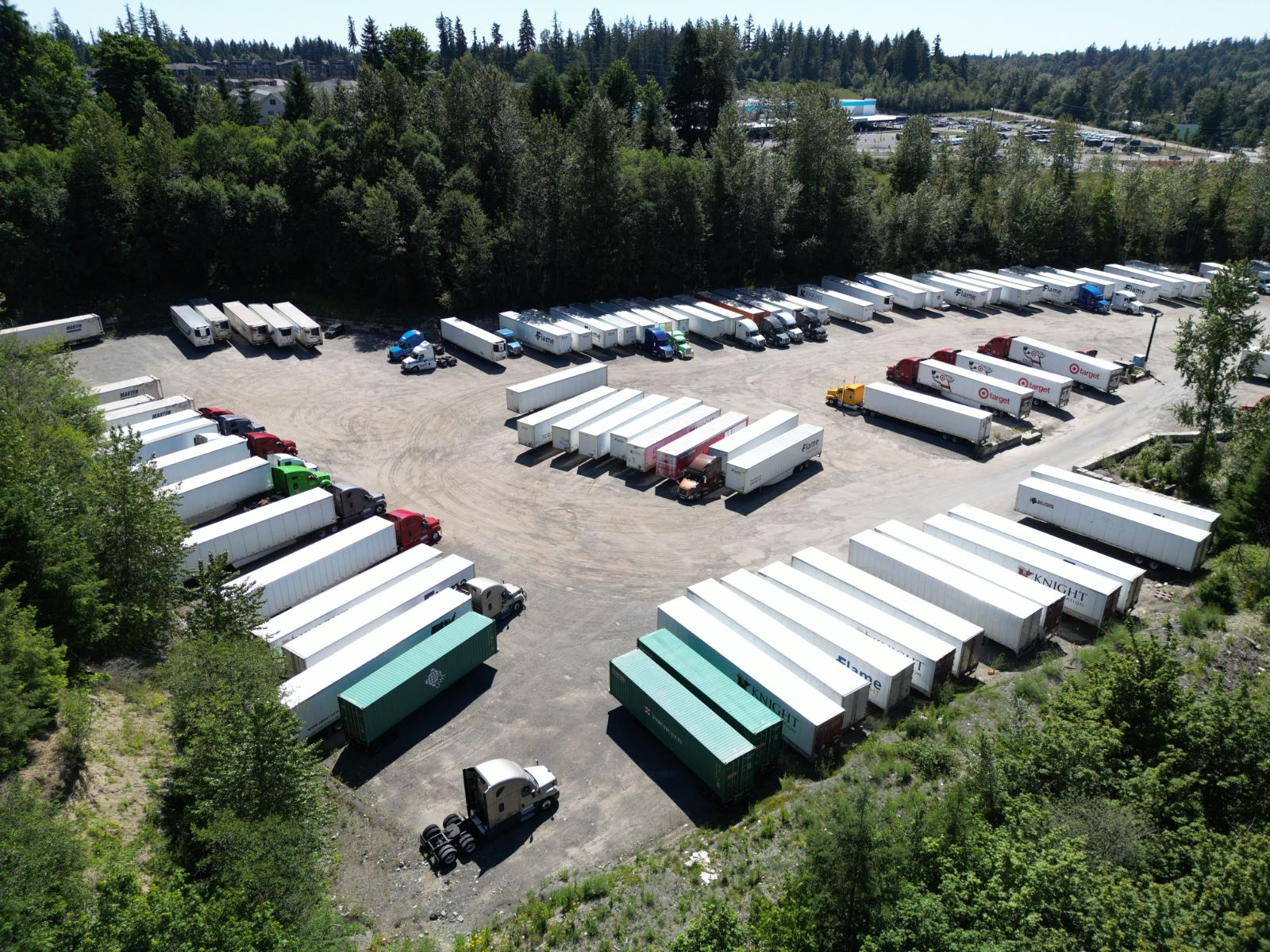
When drivers exit, the trucks they drove don't disappear — they get parked. That changes the math on overnight storage, drop yards, and short-term staging in Federal Way, Auburn, Kent,
Need a parking spot?
Browse verified truck parking across the Pacific Northwest. Daily, weekly, or monthly — your call.
Find ParkingRelated articles
Industry News
EPA 2027 NOx Rule and the Spring 2026 Proposal: What Pacific Northwest Fleets Need to Know Now
7 min read
Industry News
Why Tender Rejections Hit 14% in 2026 — And What It Means for Port of Tacoma Freight Moving Through Federal Way
6 min read
Driver Guide
Where to Charge Your Electric Truck in Kent, WA: Heavy-Duty EV Stations Near I-5 and the Kent Valley (2026 Driver Guide)
7 min read