Driver Guide
CCS vs. NACS vs. Megawatt Charging: A Kent Driver's 2026 Cheat Sheet for Class 8 EV Connectors and Pricing
If you're running a Class 8 rig out of Kent — whether you're pulling drayage from the Port of Seattle, hauling out of the Kent Valley warehouses, or staging on West Valley Highway — the EV charging pi
If you're running a Class 8 rig out of Kent — whether you're pulling drayage from the Port of Seattle, hauling out of the Kent Valley warehouses, or staging on West Valley Highway — the EV charging picture finally got a lot clearer in 2026. Three connectors now dominate the conversation: CCS1, NACS (SAE J3400), and the new Megawatt Charging System (MCS). Each one charges at a different speed, costs a different amount, and shows up at very different sites around the Puget Sound.
This cheat sheet is built for working drivers. No marketing fluff — just what plug goes where, what it costs per kWh in mid-2026, and how to plan your shift around it.
CCS1: The Workhorse You're Already Using
CCS1 (Combined Charging System) is the connector most of the early Class 8 electrics in Kent were spec'd around — Volvo VNR Electric, Freightliner eCascadia, Kenworth T680E/T880E, Mack MD Electric. CCS is the current standard for heavy-duty electric truck charging, delivering up to 350 kW. That's enough to put serious range back on a drayage truck during a 45–60 minute mid-shift break.
The good news for Kent operators: CCS is everywhere. WattEV and similar networks offer CCS and MCS rapid charging for electric Class 8 trucks at depots across the West Coast. Locally, the Northwest Seaport Alliance granted $5.12M to Zeem Solutions to develop a commercial fleet charging depot in SeaTac that will enable 250 vehicles to charge per day, with parking for 70 vehicles overnight, working with Puget Sound Energy to access 7.5MW of site capacity. If you're a drayage driver pulling Port of Seattle or Port of Tacoma containers, that depot is your bread and butter — and it runs on CCS today.
Pricing reality check for 2026: DC fast charging costs an average of $0.47 per kWh, compared with about $0.16–$0.18 per kWh at home — roughly three times more expensive. For the Pacific Northwest specifically, you catch a break: while Hawaii, New Jersey, Maine, Colorado, and California carry the highest rates, the Midwest, Plains, Northwest, and deep South have some of the lowest. Expect public CCS sessions around Kent in the $0.35–$0.45/kWh range, with depot members often paying less.
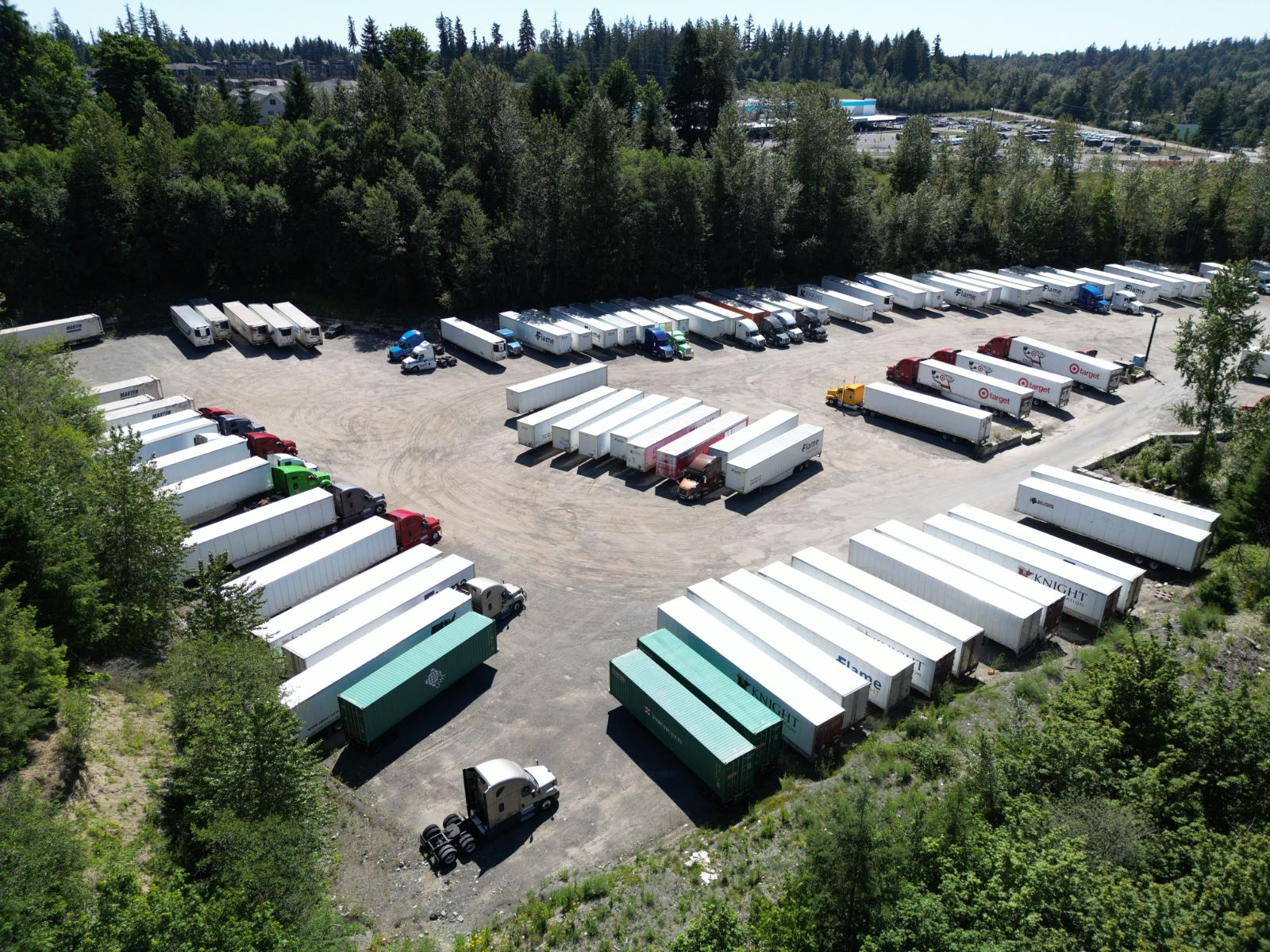
Looking for truck parking? Browse Flame Truck Parking — daily, weekly, and monthly options across the Pacific Northwest.
NACS (SAE J3400): Tesla Semi's Plug — And Why It Matters Even If You Don't Drive One
NACS is the Tesla-style connector, standardized as SAE J3400. It was developed by Tesla and is officially designated SAE J3400. For light-duty trucks and pickups it's exploding — EVgo is expanding NACS connectors across its public DC fast-charging network, with plans to reach more than 500 NACS connectors installed by the end of 2026 — but for Class 8 the story is different.
The Tesla Semi uses a beefed-up NACS-style port for its lower-power sessions and the MCS-style port for full megawatt charging. That means if you're an owner-operator in Kent running a smaller medium-duty EV (a Class 6/7 box truck, a yard tractor, or a Cybertruck-based pickup for last-mile work), NACS is increasingly your default. The 2026 Tesla Cybertruck features a NACS charging port for AC and DC fast charging, which means the model can directly access NACS charging points.
Here's the practical Kent angle: the Supercharger sites along I-5 between SeaTac and Federal Way will charge a Cybertruck or NACS-equipped pickup just fine, but they are not sized for a loaded Class 8. Don't pull a 53-footer in expecting to swing into a passenger Supercharger stall — the bays and the power simply aren't designed for it. Passenger EV charging maps are ubiquitous, but commercial trucking has very different requirements — a site that works for a sedan or SUV is likely to be unusable for a Class 8 truck hauling freight.
For pricing, NACS sessions on the Tesla Supercharger network typically run around $0.40–$0.50/kWh at typical Supercharger rates, with non-member rates in standard-cost states like Washington landing on the lower end of that spread.
MCS (Megawatt Charging System): The Game-Changer Hitting Corridors in 2026
This is the connector you need to know about. MCS is purpose-built for long-haul Class 8 trucks. MCS delivers over 1 MW of power to charge a Class 8 truck in 30 minutes or less. The MCS stations being developed today are for Class 6-8 commercial trucks and plan to deliver between 1MW and 1.68MW of power, depending on the installation.
What changed in 2026: the standard finally got locked down. The MCS connector system has been released as IEC 63379 in version 1.0 in February 2026. That's a big deal because it means truck OEMs and charging hardware vendors can now build to a stable spec without worrying about plug obsolescence.
The corridor news matters even more for Kent drivers running I-5 south to California or east toward the Tri-Cities and beyond. On January 27, 2026, Tesla and Pilot Travel Centers announced a partnership to deploy MCS-capable charging infrastructure for Tesla Semi trucks at select Pilot locations along major U.S. freight corridors, including I-5 and I-10. The first sites are expected to open in Summer 2026, with four to eight megawatt-scale charging stalls per location and power levels of up to 1.2 MW per stall. If you're running OTR with a Semi, that's the network that's about to make I-5 viable.
The first live North American MCS session is already real: EV Realty's San Bernardino hub is built with heavy-duty charging in mind, including a 1,200 kW Kempower Power Unit connected to two Kempower Mega Satellite MCS dispensers that together can deliver up to 1.2 MW and 1,500 amps of continuous power.
One thing to budget for: MCS pricing is still settling, but expect a premium over CCS. Demand charges dominate MCS economics and megawatt peaks turn "rare events" into "billing events." Site operators have to recover those costs, so plan on rates in the $0.50–$0.65/kWh range at public corridor MCS sites until utilization scales up.
Quick Reference: What to Pull Into Around Kent
- CCS1 — Your daily driver. Best for Volvo VNR, eCascadia, Kenworth T680E/T880E. Find it at the SeaTac depot, Kent Valley fleet yards, and public DCFC sites. Plan ~$0.35–$0.45/kWh.
- NACS (J3400) — Light/medium-duty and Tesla Semi low-power sessions. Skip it for Class 8 unless it's a truck-rated stall. Plan ~$0.40–$0.50/kWh.
- MCS — Corridor-only for now. Watch for Pilot sites opening on I-5 this summer. Plan ~$0.50–$0.65/kWh but 30-minute full charges.
And one Kent-specific note: Washington's incentives are still real money. A Class 8 diesel costs about $160,000 versus $600,000 for the electric version, but voucher applicants can also ask for more money to install charging infrastructure. If you're an owner-operator weighing the switch, the WAZIP voucher plus the Seattle/N
Need a parking spot?
Browse verified truck parking across the Pacific Northwest. Daily, weekly, or monthly — your call.
Find ParkingRelated articles
Operator Playbook
How Auburn Lot Owners Can Tap Washington's $112M Heavy-Duty EV Voucher Program to Justify On-Site Truck Charging
6 min read
Operator Playbook
I-5 Freight Corridor EV Charging: Why Auburn Truck Lots Are Prime Sites for 2026 NEVI-Funded Build-Outs
6 min read
Operator Playbook
Stacking the 30% Federal EV Charging Tax Credit with Washington's 50% Infrastructure Credit: An Auburn Operator's ROI Playbook
6 min read