Operator Playbook
From Overnight Parking to Overnight Charging: How Auburn Operators Can Add Depot-Style EV Bays Without Losing Stall Revenue
Auburn sits at the operational center of the Kent Valley — the busiest warehouse and distribution corridor in the Pacific Northwest. If you run a truck lot here in 2026, you've already noticed the shi
Auburn sits at the operational center of the Kent Valley — the busiest warehouse and distribution corridor in the Pacific Northwest. If you run a truck lot here in 2026, you've already noticed the shift: regional drayage out of the Port of Seattle and Tacoma, last-mile fleets serving SeaTac, and yard tractors at the big DCs along West Valley Highway are increasingly arriving in electric configurations. The smart play isn't to gut your diesel-friendly stall plan and chase a depot conversion. It's to add a handful of overnight charging bays alongside what already pays the bills.
Done right, "overnight truck EV charging Auburn" becomes a premium SKU on top of your existing inventory — higher nightly rate, longer dwell, stickier tenants — without sacrificing the per-stall revenue that keeps the lights on.
Why Auburn Is the Right Market for Depot-Style Bays in 2026
The regulatory pressure is real and it lands hardest on fleets domiciled in your zip code. In Washington, Advanced Clean Trucks took effect with model year 2025, which has a 7-11% ZEV sales/credit requirement, matching the 2025 requirement in California. That mandate is now flowing into the trucks rolling onto your lot. On the demand side, Washington just opened the funding tap: the state established WAZIP (Washington Zero-Emission Incentive Program) using Climate Commitment Act funds to help truck owners cover the costs of electric medium- and heavy-duty vehicles and charging infrastructure, and WAZIP funds are available as of April 2026. A separate $112 million voucher program will provide point-of-sale incentives for the purchase of medium and heavy-duty electric vehicles as well as off-road equipment.
Translation for operators: more electric Class 6–8 trucks are about to be parked overnight within five miles of your gate, and many of them won't have home-depot charging because their owner-operators or smaller fleets lease yard space — from you.
The technical match is also favorable for Auburn lots. Overnight private depot charging is generally the most attractive option for electric buses and trucks, given the lower power requirements and typically lower cost. You don't need to build a megawatt highway plaza. You need predictable, plug-in-at-19:00, unplug-at-05:00 bays that match how your tenants already use the lot.
The Hybrid Lot Model: Don't Convert, Append
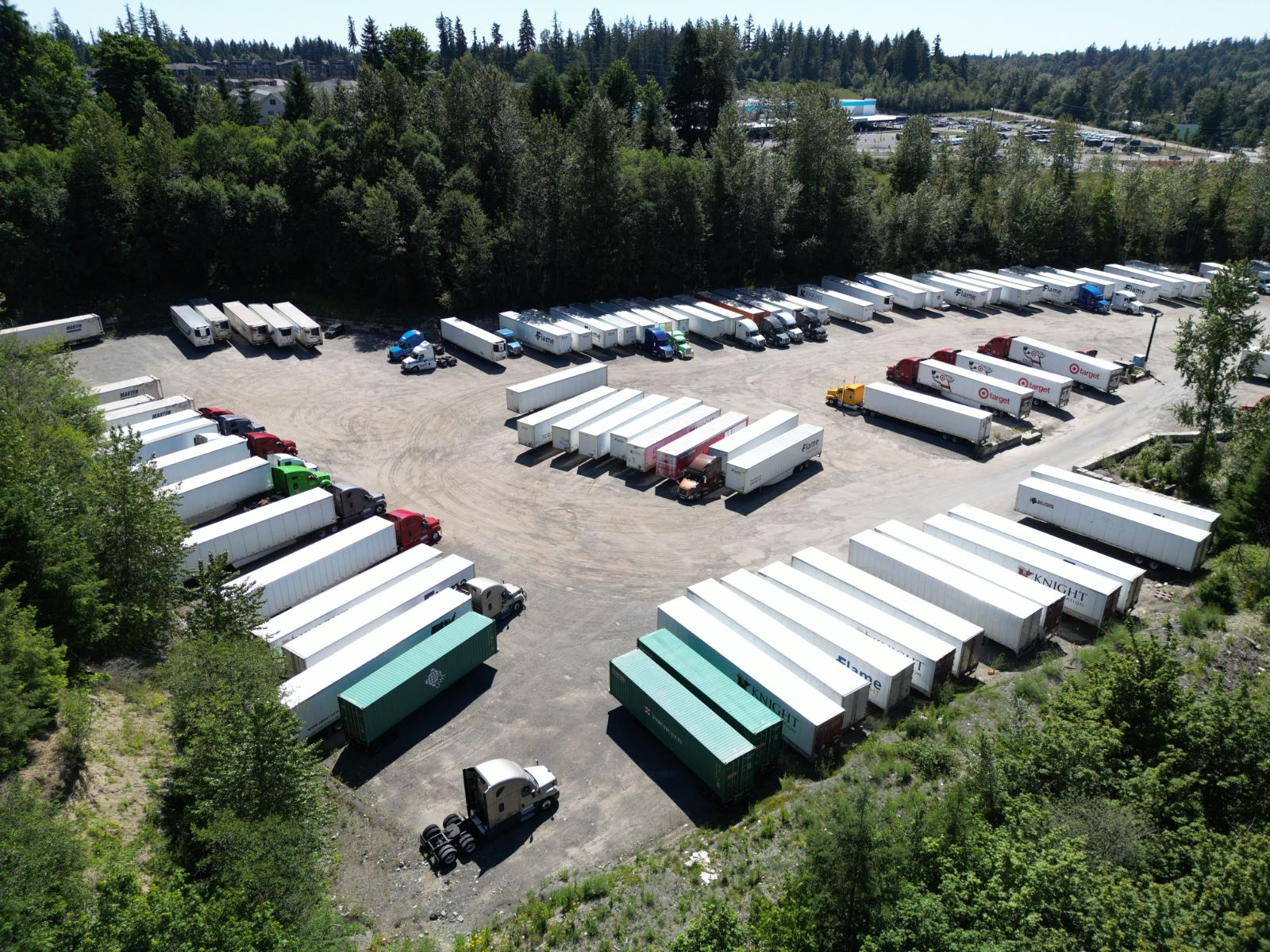
The mistake most operators make is treating EV charging as a replacement strategy. It isn't. Long-haul diesel rigs aren't disappearing from Auburn anytime soon — they're still your floor revenue. The model that works is appending a dedicated EV "row" to your existing footprint.
Start with 6–12 bays in the back or side of the lot — wherever your electrical service entrance lives — and feed them with Level 2 (AC) and a small number of moderate-power DC units. Level 2 (7-19 kW) for overnight charging is the lowest cost per kWh and gentlest on batteries, sufficient for equipment returning daily, while DC fast (50-350 kW) handles rapid turnaround when a machine needs to go back to work within 1-2 hours, or for opportunity charging during breaks. For your overnight-dwell tenants, that means roughly DC fast chargers in the 30–150 kW range typically match overnight dwell time for regional haul or delivery duty cycles, with higher-utilization depots or those running two shifts needing 150–400 kW units.
Looking for truck parking? Browse Flame Truck Parking — daily, weekly, and monthly options across the Pacific Northwest.
The revenue math is straightforward. A standard Auburn overnight stall today rents in the mid-$20s to mid-$30s per night. An equivalent stall with a managed Level 2 connection — billed as a bundled "parking + energy" SKU — clears $50–$90 per night depending on kWh delivered, with the kWh margin going to you. You're not cannibalizing diesel revenue; you're carving out 10–15% of your stall count for a premium product that books out months in advance once the local fleets know it exists.
Make-Ready, Utility Programs, and Avoiding the Trap
The single biggest cost barrier for an Auburn operator isn't the chargers themselves — it's the service upgrade. This is where Puget Sound Energy becomes your most important business partner.
Puget Sound Energy (PSE) offers make-ready incentives for EV charging infrastructure through its Up & Go Electric programs, specifically for multifamily properties, workplaces, and fleets, covering costs associated with preparing sites for EV charger installation, such as utility-side and customer-side electrical infrastructure upgrades. For commercial truck parking, the fleet track is what you want. PSE's turnkey service plans and implements the necessary make-ready infrastructure upgrades and manages permitting and installation of EVSE, and also covers networking and ongoing maintenance for 10 years, reducing your operation and maintenance costs.
Two more incentives to stack: the 30C infrastructure credit (30% up to $100K — check current 2026 IRS guidance), NEVI corridor funding, and EV-specific utility rate structures remain in play, alongside state fleet electrification programs. And PSE's program offers a total maximum incentive of $250,000 per charging location, with the customer paying make-ready infrastructure upgrade fees above maximum allowance. Between PSE make-ready, WAZIP infrastructure dollars, and the 30C credit, well-structured Auburn projects can recover the majority of capex.
One operational warning: don't oversize. A single electric truck battery (200-600+ kWh) draws the same power as an entire big-box retail store during charging, and scaled to 10-50 machines at a depot you need megawatts of capacity — more than most commercial sites have available without major grid upgrades. The whole reason overnight L2 works is that you spread the load across 10–12 hours. Adding even one or two 350 kW DC stalls without managed charging will trip you into a demand-charge tier that destroys your margin. Insist on load management software from day one.
Designing for Tenant Stickiness and Stall Revenue
Layout matters more than horsepower. Auburn fleets running yard tractors, drayage day cabs, and step vans need pull-through or angled bays — not the parallel-park nightmare you see at retail charging stops. Reserve EV row for vehicles that will physically dwell 8+ hours. Keep your DC fast units near the gate for opportunity sessions and short-stay tenants who pay a premium for a 90-minute top-off between runs.
Pricing should be tiered. Sell the bay as a monthly reservation (your highest-margin product), then a nightly drop-in rate, then a per-session DC rate. Bundle kWh into the monthly rate up to a cap, then bill overage. This locks in occupancy on the EV row while keeping a casual-use revenue stream. Critically, this protects your diesel stall count — you're not converting, you're adding a premium tier.
The fleets that need this most are exactly the ones that won't build their own depots: heavier trucks are harder to come by than electric delivery vans like Amazon's ubiquitous Rivian vans, while heavy trucks remain prohibitively expensive for many companies, and lacking public charging infrastructure is a key concern. That's your opening. Be the public-but-reserved infrastructure within a 10-minute deadhead of every warehouse on West Valley Highway.
List Your Auburn EV-Ready Bays on Flame Truck Parking
Once your first EV row is energized, demand discovery is the next bottleneck — the regional fleets that need overnight truck EV charging in Auburn aren't going to find your lot through a Google search. Flame Truck Parking surfaces your EV-capable bays directly to the drayage, last-mile, and regional carriers running the Kent Valley, with filters for connector type, power level, and overnight availability. List your hybrid lot with us and turn your new charging row into booked revenue from the first month it's live.
Need a parking spot?
Browse verified truck parking across the Pacific Northwest. Daily, weekly, or monthly — your call.
Find ParkingRelated articles
Industry News
What the 2026 Truckload Spot Rate Surge Means for Pacific Northwest Shippers and Consumers
6 min read
Industry News
Washington's Advanced Clean Trucks Rule in 2026: How ZEV Mandates Are Reshaping Federal Way Freight
6 min read
Industry News
The Driver Shortage Is Back: How English Proficiency Enforcement and CDL Crackdowns Are Tightening Capacity in 2026
6 min read